 “HELLO THERE”
By Robert M. Howard
“When we first came in we didn’t think people would ever take over the Sandhills.”
These are the words of 89-year-old William M. Gibson of Mullen, who, in nearly 70 years’ time has assembled quite a knowledge of the central Sandhills.
Halted by the Blizzard of 1888 north of Tryon after he had struck out from Custer county with a four-horse rig, the 21-year-old Gibson got no further toward his Hyannis destination and doesn’t regret it today. In the community of Omega post office he was “talked into” staking a claim when the county seat of McPherson county was known as McPherson. (In the fall of 1892 the name of the county seat was changed from McPherson to Tryon). In 1890, at the time of the organization of McPherson county, the population of McPherson and Arthur counties combined (Arthur county was unorganized territory) was reported in the census as 401.
Building a court house for McPherson county was one of the first acts of the new county officers. The building was constructed of sod, with a high frame roof. The courthouse was to become the social center of the community, and all meetings were held there.
In fact it was here that William Gibson met his bride-to-be, Sadie Brown, a homesteader from in east of the M. A. Connell place.
They had just built a court house and the neighboring folks wanted to hold a dance,” Gibson recalled. “ ‘Just nail the floor down and go to it’, we were told and that’s what we did.”
It has been recorded that on many occasions the homesteaders and cowboys gathered to dance to fiddle music of the western songs and dance tunes popular in those days of the nineties. These dances seldom ended until daybreak and were most often held on Friday nights, so the dancers might transact their legal business the following day before going home.
This was one of the recollections that William Gibson had when he, his six sisters and succeeding generations gathered in reunion at Tryon in 1940. And he recalled this and similar circumstances when his immediate family honored him at the Episcopal Church in Mullen, January 29 this year in observance of his eighty-ninth birthday.
The first child and only son of Alexander and Ellen (Morrison) Gibson, William Morrison Gibson was born January 29, 1867, at Rock Island, Illinois. Both of the parents came to America from Ireland, the mother having come across with her four brothers, settling in Illinois.
When our subject was at a young age the family moved to Keokuk, Iowa, where he remembered his father “ditched the old Iowa sloughs with oxen and farmed with one horse.”
Before the elder Gibson was to move on to the West his family had increased to seven, William’s arrival being followed over a seventeen year period by six sisters. These were MAGGIE (Mrs. John Hazelbaker who later was to live south of Hyannis); MARY (Mrs. Elmer Neal of 13 miles north of Tryon; SARAH (Mrs. William Thomas Haney, who lived southeast of Eclipse Church); AGNES (Mrs. Orin Thompson, west of the M. A. Connell place in McPherson county); ELLA (Mrs. Arthur Bowers of Montana) and ANNIE (Mrs. William Le La Cheur, Hot Springs, South Dakota).
Our subject was educated in a rural Iowa school of 50 to 60 till he was fourteen, then went another winter in Nebraska.
Arriving in Nebraska when the son William was 17 years old, the Gibson family settled for a couple of years in Fillmore county. Here they became acquainted with a Sandhiller by the name of Fred Stuckey (from Baldy Valley south of Whitman) who brought into the county a number of work horses. Stuckey went to Oregon and got the horses, Gibson explained, then sold them out in various parts of Nebraska for all the way from forty to eighty dollars per head.
After his parents moved to Custer county, Nebraska, young Bill Gibson freighted between Broken Bow and their place 18 miles south on the Loup. A January ’88 blizzard caught him driving into the Bow for a load of lumber and he recalls that the horses turned by instinct toward the sod livery stable or he would have missed it. After the weather cleared he managed to get home by riding one of the horses. In March of the same year, after he’d just turned twenty-one, Gibson was inspired to strike out by himself toward the White Water Ranch and the place of Fred Stuckey up on the Sandhills.
 “I hitched up four horses on an old wagon and set out,” he recounted his westward trek. Everything went well save for the remoteness of settlements above North Platte.
“There were very few places between the Platte and Dismal when I came; in fact it was mostly all bunch grass,” he said.
The second blizzard of 1888, and the history records it as the most severe in the memory of Nebraska people, denied young Gibson from proceeding beyond a point eleven miles north of the present town of Tryon. Living up there were M. A. Connell, Hugh Bedell and Ernest and Owen Wisner—these were the only names in that part of the country, the Mullen octogenarian pointed out. Wisners ran the Omega post office and it was Mike Connell, who down through the years, was recognized as holder of the first tax receipt issued in McPherson county.
Connell and Gibson had quite a bit in common, although Mike was ten months older; had lost both parents when he was 17; and had been in the Sandhills since July of the preceding year; each was on his own in a remote part of the country. It is easy to understand that Connell would invite his new immigrant friend to “stay out” the March Blizzard of ’88 with him, then “talk him into” homesteading nearby.
Later in the same month Gibson filed at North Platte for the homestead about eleven miles north of Tryon. Soon he laid up a sod house and proceeded to remain there about seven years.
On January 9, 1892, at Omega, Nebraska, William Gibson married the lady he had met first at the McPherson county court house dance a couple years before. The bride, Sadie Brown, was a homesteader though she was raised near Arnold in Custer county. Her parents were immigrants from Scotland.
Later the couple sold their McPherson county place and moved into Mullen where he did freighting and worked for a while on the railroad construction. About 1905 they moved 14 miles northwest of Mullen on a homestead. Their first three children, John Albert, William Franklin and Clarice Irene, were born north of Tryon and the fourth, Pearl Lucille, on the Cherry county homestead.
It was about 1892 that William Gibson’s parents came up from Custer county and homesteaded north of Lena post office. The location was southeast of the Tucker place, later where Tom and Sarah Haney ranched.
Mr. Gibson’s parents are buried at Eclipse cemetery. Before their passing they had lived in Mullen.
While he was on the Tryon homestead, Mr. Gibson hauled corn that he raised to Haneys up toward Hyannis. It was particularly hard to farm, he said, because cattle herds ran on the open range and were rounded up but once a year. In making such trips he came to meet “Cap” Haskell, one of the founders of the Milldale Ranch. Gibson mused as he repeated Haskell’s prediction that “‘The Sandhills haven’t flowered out yet but I suppose they will sometime’.”
“I thought I could ride a long way, but I couldn’t outride Cap Haskell,” the Mullen pioneer conceded.
Various means were sought by the young homesteader in securing a livelihood. “We shot prairie chickens and got $1.25 each. Lowe would barrel them up and ship them east.
“Why the first summer out here we just lived on antelope meat. Hauled all kind of wood off the Dismal for firewood and posts. We’d camp up there for a couple or three days getting a load.
“Once coming back from the Dismal, fresh snow had fallen. As I drove along through the Shimmin Valley the horses shied, one going on either side to avoid a hump partly covered by snow in the road. I stopped and investigated and found the body of a man frozen in the snow.
“No one ever learned the man’s identity. One of the families living near, the Uptons or Klings, had advised a traveler against proceeding on foot in winter time, and this was probably the man who never heeded their warning.
“Anyway we buried the man alongside the road.
“In the earlier years you never thought about going to Mullen because you could hardly get through the Dismal river hills. Only an occasional man on horseback would make the trip.
“Most of our freighting was done out of North Platte—fifty miles away. Why, a team wouldn’t be any good for several days after that trip.
“We got to selling butter or cream to Mike David after he got established at Tryon. Earlier, Mike walked through the hills with a pack of merchandise and a lot of us bought some items that way. There sure was an honest man.”
At the Cherry county homestead neighbors of the Gibsons were names yet familiar today: Clemens, Prentice, A. B. Cox; George Weise came in a few years later; E. P. Ericksen followed as did Albert Ericksen. The Kinkaid Act brought new folks and the country began filling rapidly.
 Mrs. William Gibson passed away in April, 1922, and in 1930 the Cherry county place was sold. This is the present ranch location of Clyde Le La Cheur.
Mr. Gibson and his six sisters have been a long-lived family. They were all present at the Tryon reunion in 1940 and all living up to last year when Annie (Mrs. Le La Cheur) died, followed by Sarah (Mrs. Haney) the same year. Mrs. Haney’s son, Roy, ranches out of Mullen. At the present, Mrs. Hazelbaker lives at Walla Walla, Wash.; Mrs. Bowers, Hamilton, Mont.; Mrs. Thompson, Leroy, Iowa, and Mrs. Neal, North Platte.
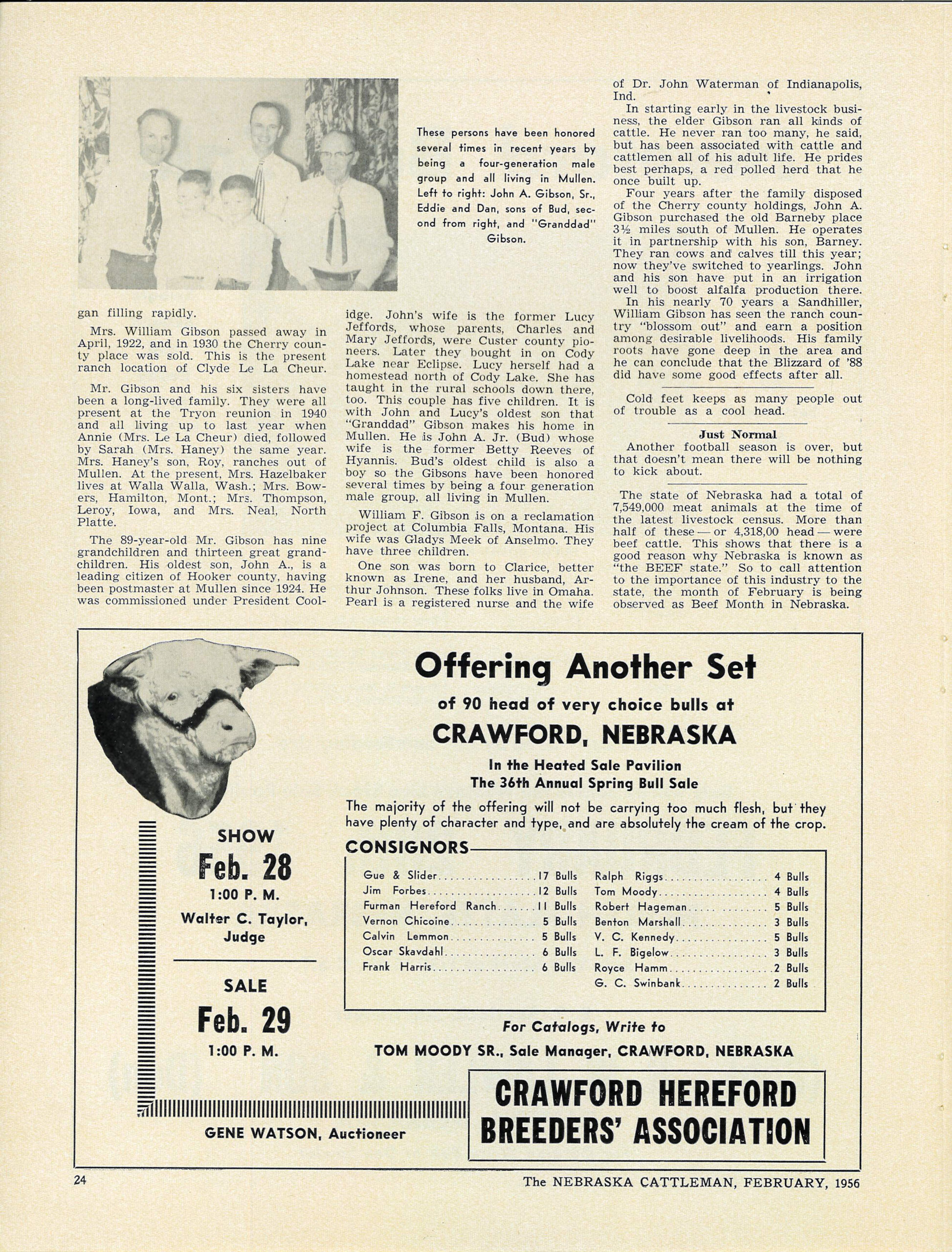
The 89-year-old Mr. Gibson has nine grandchildren and thirteen great grandchildren. His oldest son, John A., is a leading citizen of Hooker county, having been postmaster at Mullen since 1924. He was commissioned under President Coolidge. John’s wife is the former Lucy Jeffords, whose parents, Charles and Mary Jeffords, were Custer county pioneers. Later they bought in on Cody Lake near Eclipse. Lucy herself had a homestead north of Cody Lake. She has taught in the rural schools down there, too. This couple has five children. It is with John and Lucy’s oldest son that “Granddad” Gibson makes his home in Mullen. He is John A. Jr. (Bud) whose wife is the former Betty Reeves of Hyannis. Bud’s oldest child is also a boy so the Gibsons have been honored several times by being a four generation male group, all living in Mullen.
William F. Gibson is on a reclamation project at Columbia Falls, Montana. His wife was Gladys Meek of Anselmo. They have three children.
One son was born to Clarice, better known as Irene, and her husband, Arthur Johnson. These folks live in Omaha. Pearl is a registered nurse and the wife of Dr. John Waterman of Indianapolis, Ind.
In starting early in the livestock business, the elder Gibson ran all kinds of cattle. He never ran too many, he said, but has been associated with cattle and cattlemen all of his adult life. He prides perhaps, a red polled herd that he once built up.
Four years after the family disposed of the Cherry county holdings, John A. Gibson purchased the old Barneby place 3½ miles south of Mullen. He operates in partnership with his son, Barney. They ran cows and calves till this year; now they’ve switched to yearlings. John and his son have put in an irrigation well to boost alfalfa production there.
In his nearly 70 years a Sandhiller, William Gibson has seen the ranch country “blossom out” and earn a position among desirable livelihoods. His family roots have gone deep in the area and he can conclude that the Blizzard of ’88 did have some good effects after all.
Cold feet keeps as many people out of trouble as a cool head.
Source:
Nebraska Cattlemen Magazine
February 1956
Pages 20-24

Leave a Reply